
Blogs
|MARCH 23, 2026
Understanding Public Behavior in Sri Lanka: What It Means for PR Strategy and Crisis Communication
Nevindee Amarasinghe
Introduction
Public relations is often approached as a function of messaging. What to say, when to say it, and where it should appear. But in reality, effective PR depends just as much on how people think, react, and share information. As we touched up on an earlier blog: in Sri Lanka, public behavior is shaped by a unique mix of cultural values, community influence, trust dynamics, and rapidly spreading information networks. Understanding how the public responds to information is essential for building effective PR strategy, managing crises, and protecting long-term brand reputation.
The Role of Community and Word-of-Mouth
Sri Lanka is a deeply community-driven society. Information does not flow only through media channels, but it travels quickly through family networks, neighbourhood conversations, and informal digital spaces such as WhatsApp groups. So during a crisis you will most likely hear the people believing the people around them before they watch the news or refer to any media outlet.
People often place greater trust in what they hear from someone they know than what they read in an official statement. This makes word-of-mouth one of the most powerful, and unpredictable forces shaping public perception.
For brands, this means that once a narrative begins circulating within communities, it becomes significantly harder to control. PR strategies must therefore anticipate how messages will be interpreted and shared at a grassroots level, not just how they are presented in the media.
Herd Mentality and Panic Reactions
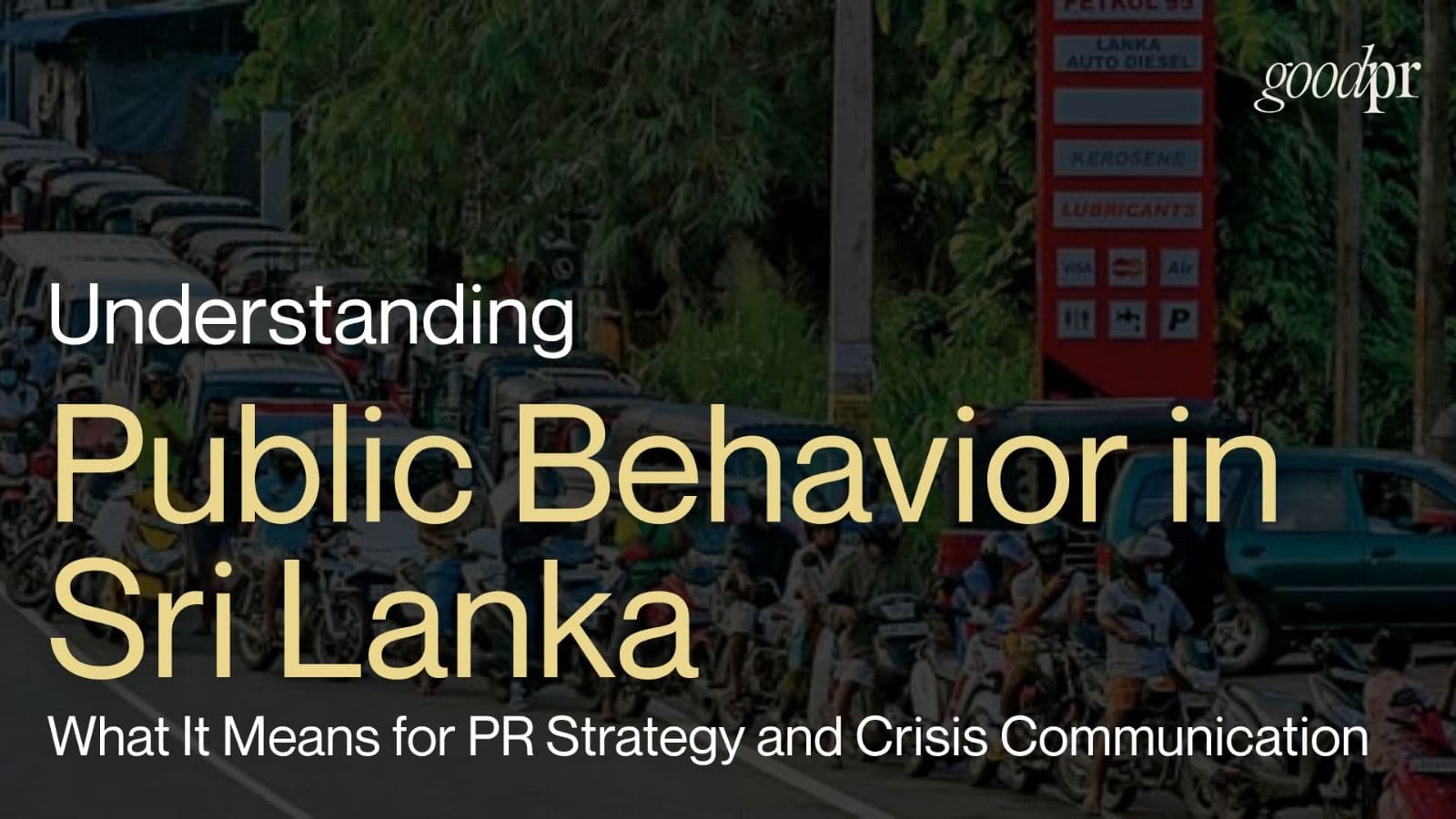
Public behavior in Sri Lanka is also strongly influenced by herd mentality, particularly during periods of uncertainty. When people see others reacting a certain way, they tend to follow the same, often without verifying information independently.
We can see this happening right now with people panic buying fuel and groceries following the war in the middle east and global supply route disruptions. This situation highlights a key reality: perception can override facts. Fear, urgency, and collective behaviour can escalate a situation far beyond its actual severity.
For brands, this underscores the importance of early, credible communication. Once panic sets in, it becomes significantly more difficult to correct narratives.
Trust and Distrust in Information Sources
Public trust in Sri Lanka is complex and often selective. While traditional media outlets such as newspapers and television are generally viewed as credible, there is also a level of skepticism, particularly around government communications and the perception that some media coverage can be influenced or “bought.”
As a result, audiences tend to cross-reference information, rely on personal networks, or gravitate toward sources they already trust. This creates a fragmented information environment where not all messages are received equally.
For brands, simply issuing a statement is not enough. Where the message appears, and who communicates it, plays a critical role in whether it is believed.
The Speed of Misinformation
In today’s media environment, misinformation spreads faster than ever. Social media platforms, combined with strong community networks, allow rumours to circulate rapidly, often outpacing verified information.
Corrections, even when issued promptly, tend to travel slower than the original claim. This creates a challenging environment where brands must not only communicate effectively but also actively monitor and respond to misinformation in real time.
Ignoring false narratives rarely makes them disappear. In many cases, silence allows them to grow.
What This Means for PR Strategy and Crisis Communication
Understanding public behaviour is fundamental to building an effective PR strategy in Sri Lanka. Communication must go beyond messaging and consider how information will be received, interpreted, and shared.
This means:
- Developing clear, consistent messaging that can withstand reinterpretation
- Leveraging trusted media relationships to reinforce credibility
- Responding quickly to prevent misinformation from gaining traction
- Aligning communication with cultural and social sensitivities
- Treating reputation management as an ongoing process, not just a reactive measure
Crisis communication, in particular, requires a balance between speed and accuracy. Brands must act quickly, but not at the expense of clarity or credibility.
In a landscape where perception can shift rapidly, control comes from preparation, not reaction.
Conclusion
Public behaviour in Sri Lanka is shaped by community influence, cultural context, trust dynamics, and the rapid spread of information. For brands, this creates both a challenge and an opportunity.
While it is impossible to control how people react, it is possible to influence how information is communicated and understood. Brands that invest in strategic PR, strong media relationships, and culturally aware messaging are better positioned to navigate uncertainty and maintain trust.
In the end, effective public relations is not just about what a brand says, it is about how well it understands the people it is speaking to.
At Good PR, we help brands navigate Sri Lanka’s complex media and public landscape through strategic communication, strong media relationships, and culturally informed PR strategies. If your brand is looking to build credibility, manage perception, and respond effectively in times of uncertainty, our team is here to help 🙂
By – Shevan Gomis
PR & Events Associate – GOOD PR PVT LTD
Read Next

Blogs
PR Value and Advertising Value: What They Mean and Why They Matter
Something that most of our clients ask after they receive the PR report is, what are these values highlighted as PR value and Advertising value. If you also thought the same, you’re not alone. PR value and Advertising value are the most commonly cited metrics in any campaign report, but they rarely get a proper […]
Read Narrative →
Blogs
Why Trilingual Media Monitoring Is the Foundation of Any Serious PR Strategy in Sri Lanka
Sri Lanka’s media landscape does not operate in one language, and neither does public opinion. For any public relations agency operating here, or any brand running PR services, treating media coverage as a single language feed isn’t just incomplete but a liability. Three Voices that shape perception Understanding media relations in Sri Lanka means understanding […]
Read Narrative →